
Celebrate the season of joy and togetherness with home appliances that make life easier and celebrations grander!
Festive Discounts • Free Gifts • Easy EMI

Pedestal Fan vs Air Cooler: Which Is Right for Your Home?
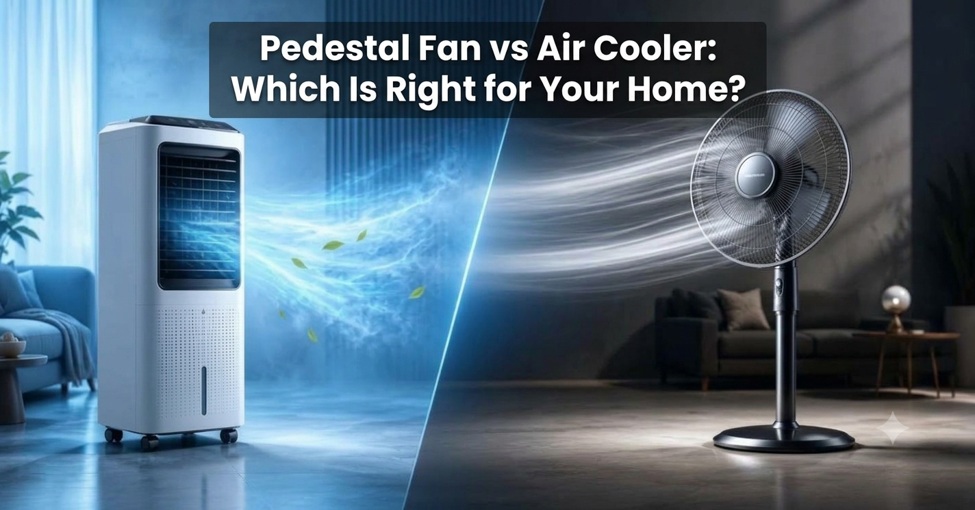
When summer arrives, keeping your home comfortable becomes a priority. While an air conditioner offers powerful cooling, it can also increase electricity bills. That is why many households consider more affordable alternatives such as pedestal fans and air coolers.
But which one is better for your home?
A pedestal fan and an air cooler work in completely different ways. A pedestal fan circulates air to create a cooling sensation, while an air cooler uses water evaporation to provide cooler air. The right choice depends on your climate, room size, ventilation, electricity consumption, maintenance requirements, and budget.
Pedestal Fan
A pedestal fan is a free-standing electric fan mounted on an adjustable stand. It uses rotating blades to circulate air around a room.
Modern pedestal fans usually offer multiple speed settings, oscillation, adjustable height, and different operating modes. Some models also include remote controls, timers and digital displays.
A pedestal fan does not reduce the actual temperature of the room. Instead, the moving air helps sweat evaporate from your skin, making you feel cooler.
Benefits of a Pedestal Fan
- Lower electricity consumption
Pedestal fans generally consume relatively little electricity compared with air coolers and air conditioners. This makes them suitable for regular daily use.
- Easy to move
Because they are portable, you can easily move a pedestal fan from the bedroom to the living room, dining area or another space.
- Simple maintenance
There is no water tank, pump or cooling pad to maintain. Regular cleaning of the blades and protective grille is usually sufficient.
- No water required
A pedestal fan can operate continuously without needing a water supply or tank refilling.
- Good air circulation
Its oscillating movement can distribute air across a wider area, making it useful for improving air circulation in a room.
Air Cooler
An air cooler, also known as an evaporative cooler, uses the natural process of water evaporation to cool the air.
Warm air is drawn into the cooler and passed through water-moistened cooling pads. As the water evaporates, heat is absorbed from the air. The cooler then blows the cooled air into the room.
Unlike a regular fan, an air cooler can actually lower the temperature of the air coming out of the appliance.
Benefits of an Air Cooler
- Stronger cooling effect
Air coolers can provide significantly cooler air than a conventional fan, especially in hot and dry weather.
- Suitable for larger spaces
Many air coolers are designed to deliver a high volume of air, making them useful for living rooms, halls and other larger spaces.
- Lower running cost than AC
An air cooler generally consumes considerably less electricity than an air conditioner, although actual consumption varies by model and usage.
- Water-based cooling
Instead of using a refrigeration compressor like an AC, an air cooler relies on evaporation, making its cooling mechanism relatively simple.
- Fresh-air operation
Air coolers work best when there is adequate ventilation. Opening a window or door slightly can help humid air escape and allow the cooler to work more effectively.
Which Is Better for Humid Weather?
Climate is one of the most important factors when choosing between these two appliances.
Air coolers depend on evaporation. When the surrounding air already contains a lot of moisture, water evaporates less effectively. As a result, the cooling performance of an air cooler can decrease.
In humid or coastal regions, a pedestal fan can therefore be a more practical choice. It does not add additional moisture to the room and can provide comfortable airflow without requiring water.
For hot and dry regions, however, an air cooler can be much more effective.
Which Uses Less Electricity?
In general, a pedestal fan uses less electricity than an air cooler.
However, actual electricity consumption depends on the motor power, operating speed, usage duration and model.
For example, if you operate an appliance for several hours every day, even a small difference in power consumption can affect your monthly electricity bill.
If your primary requirement is air circulation rather than temperature reduction, a pedestal fan can be the more economical option.
Which Is Better for a Bedroom?
For a bedroom, the choice depends on your climate.
A pedestal fan can be a good option if you mainly need comfortable airflow while sleeping. Its simple operation and relatively low power consumption make it convenient for long hours of use.
An air cooler may be preferable in a hot and dry environment, particularly if the bedroom becomes very warm during summer.
However, remember that an air cooler needs proper ventilation. Using one in a completely closed room can increase humidity and reduce cooling effectiveness.
Which Is Better for a Living Room?
For a larger living room, an air cooler may provide stronger cooling, particularly during hot and dry weather.
A high-air-delivery cooler can circulate a large volume of air, while a pedestal fan can help distribute air across the room.
The size and layout of the room should therefore be considered before choosing the appliance.
Noise Level
Noise is another factor worth considering.
Pedestal fans generally produce the sound of their rotating motor and blades. Some modern models are designed to operate more quietly at lower speeds.
Air coolers have additional components such as a water pump and fan motor, so their operating sound can vary depending on the design and speed setting.
If you are particularly sensitive to noise while sleeping or working, check the manufacturer's noise specifications where available.
Maintenance: Fan vs Air Cooler
A pedestal fan is relatively simple to maintain. Dust can accumulate on the blades and grille, so regular cleaning helps maintain airflow and performance.
Air coolers require more attention because they contain a water tank, pump and cooling pads.
Regularly cleaning the water tank can help maintain hygiene. Cooling pads may also need cleaning or replacement depending on the type of cooler and usage.
If you want an appliance that requires minimal maintenance, a pedestal fan has an advantage.
Portability
Both appliances can be moved, but pedestal fans are generally easier to carry because of their relatively simple and lightweight construction.
Air coolers can be heavier, particularly models with larger water tanks.
If you frequently move your cooling appliance between rooms, portability should be part of your buying decision.
What About Water Consumption?
Unlike a pedestal fan, an air cooler requires water.
The amount of water consumed depends on the tank capacity, operating speed, ambient temperature, humidity and model.
If you don't have convenient access to water or don't want the responsibility of regularly filling and cleaning a tank, a pedestal fan may be more convenient.
Which One Should You Choose?
Choose a pedestal fan if you want an affordable, simple solution for air circulation and already have a reasonably comfortable room temperature.
Choose an air cooler if you live in a hot, dry climate and want cooler air without the higher electricity consumption typically associated with an AC.

 Continue With Google